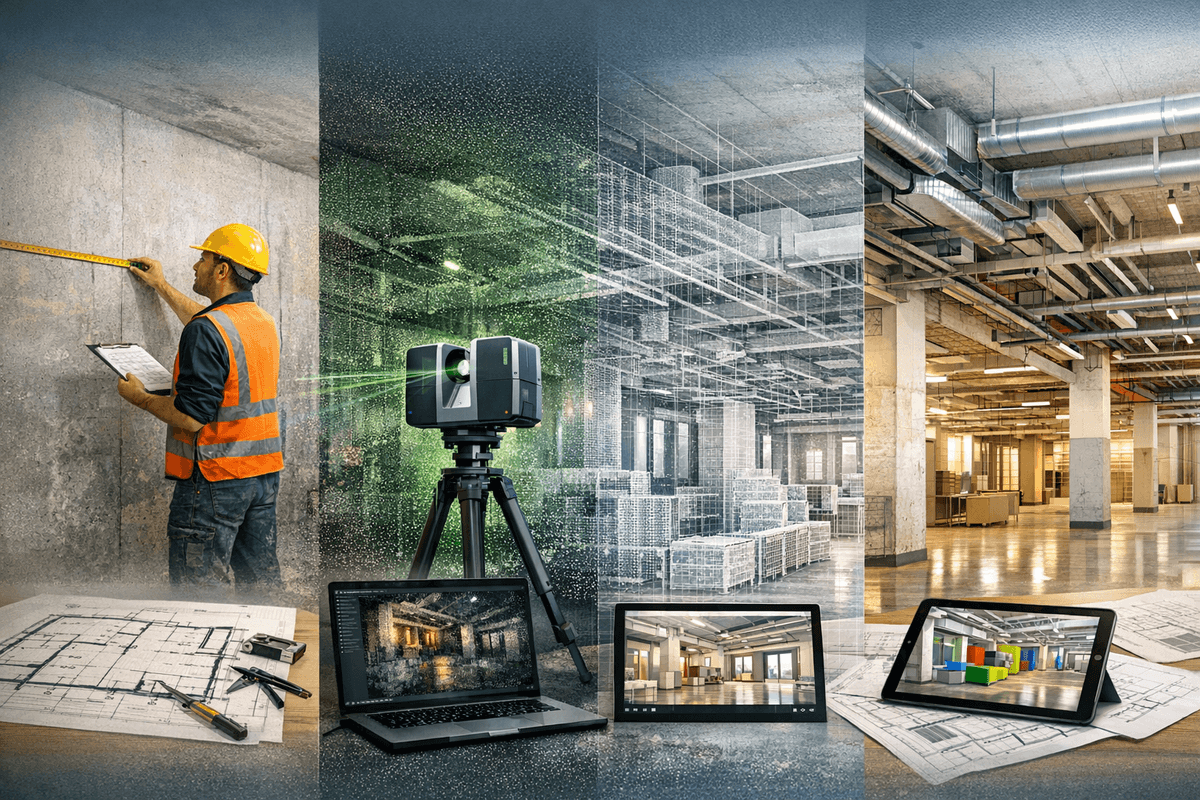
Nowadays in the interior design and construction industry, accuracy has become a main factor determining the success or failure of a project. Whether it's a residential, commercial space, or a large development project, any minute measurement error can be amplified in later stages, affecting construction quality, design effectiveness, and even increasing overall costs. Therefore, more professional teams are adopting 3D scanning technology as a crucial step in the early design phase.
3D scanning is a technology that uses high precision lasers to comprehensively collect data from a real space. Through scanning, a 3D scanner can capture millions of data points in a space in a short time, generating complete point cloud data. This data not only contains dimensional information but also accurately records the structure, angles, and detailed changes of the space. Compared to traditional measurement methods, 3D scanning does not rely on manual recording but directly reflects the real situation through data. In Iport 3D Interior Design and Build project, our design team used a high precision scanning method, controlling the overall error within approximately 1–3 millimeters, achieving a near 1:1 spatial reconstruction.
Traditional measurement is based primarily on measuring tapes, levels, and manual recording. It was commonly used in the past, but its weaknesses are now more obvious in modern design. First, manual measurement is easily affected by the environment and working conditions leading to errors. Second, complex spaces are often difficult to fully record, resulting in omissions or incomplete data. Furthermore, during the design process, insufficient data often requires multiple site visits for additional measurements, affecting overall efficiency. More importantly, these errors start small but they become bigger during construction and affect the design’s final outcome.
Through 3D scanning, the design process starts with real data making the entire project more controllable. In practice, our design team's process includes:
1. Site Preparation : The space is first cleared and prepared for scanning. This includes empty rooms, post demolition conditions, or areas that may differ from original architectural drawings. Ensuring a clean scanning environment improves data accuracy and completeness.
2. Full Space Scanning : A comprehensive scan of the entire site is conducted using 3D scanning. This process is highly efficient and usually takes only half a day to one full day depending on project size. For example, in the HLB project, scanning was completed within half a day without affecting site operations significantly.
3. Point Cloud Processing : After scanning, the collected data is processed and exported into a point cloud format. Designers then use this dataset to generate a 1:1 digital model of the space,fully copying its structure, size, and physical conditions.
4.Space Analysis & Risk Detection : The digital model is then analyzed to detect potential risk areas such as tilted walls, uneven flooring, misaligned structural elements, or different ceiling heights. These issues are often difficult to detect using traditional methods but become clearly visible in the scanned model.
5. Design Development & Documentation : Based on the verified model, accurate floor plans, elevations, and design drawings are produced. Designers can then proceed confidently into the design development stage without the need for repeated site visits or manual remeasurements.
This simply reduces the need for frequent on site verification, workflow significantly improves efficiency while ensuring a higher level of reliable design. It also allows teams to focus more on design quality and problem solving rather than basic data collection.
When design is based on millimeter level accurate data (within a 1–3mm tolerance range), its value is not only about precision.It greatly improves the overall quality, coordination, and predictability of the entire project.
Firstly, designers are able to detect possible issues early in the design phase rather than during construction. Acting early helps avoid costly on site modifications, last minute adjustments, and structural conflicts.
Secondly, complete spatial data ensures that design proposals are closely aligned with actual site conditions, improving construction accuracy and reducing differences between design and construction.
Thirdly, clear and shared digital documents improve communication between designers, contractors and project stakeholders. With everyone working from the same data set, misunderstandings are minimized and coordination becomes significantly more efficient.
Additionally, this approach helps make better project control and risk management. Since the space conditions are fully captured at the beginning, project teams can make informed decisions with greater confidence. It also improves cost estimation accuracy, as possible structural challenges and space problems are found early. This reduces the chance of unexpected changes during construction, helping projects stay on budget and on time.
Not just efficiency and accuracy, 3D scanning also helps build in a more eco friendly way. By reducing rework, minimizing material waste, and reducing mistakes on the first try,it helps make project delivery more efficient with resources. In large scale developments, even small reductions in waste and rework can lead to significant environmental and financial benefits.
Adding 3D scanning into the process also represents a move towards Building Information Modeling (BIM) workflows and digital construction ecosystems. When point cloud data is integrated into BIM systems, it makes coordination more advanced, clash detection, and lifecycle management. This connects real conditions to the design, construction, and future maintenance. As a result, buildings are no longer just physical structures but data based systems that can change over time.
3D scanning also plays a main role in improving client communication and approval processes. With accurate 3D visualizations based on site conditions, clients can better understand proposed designs and make faster, more confident decisions. This reduces changes and makes project approvals faster, especially in commercial or developer led projects where time efficiency is critical.
3D scanning is not just a technological tool, it represents the development direction of the design industry moving from experience based judgment to data based approaches. For homeowners, developers, commercial clients, and designers and architects, this method effectively reduces risk, increases efficiency, and ensures that design outcomes are actually built.
In modern design and construction environments, precision is no longer an added bonus,but a basic requirement. Using 3D scanning allows design teams to understand the real space early, avoiding unnecessary errors and cost waste. For projects that prioritize quality and efficiency, 3D scanning has become a key part.
Want to learn more? Feel free to DM us for more information.